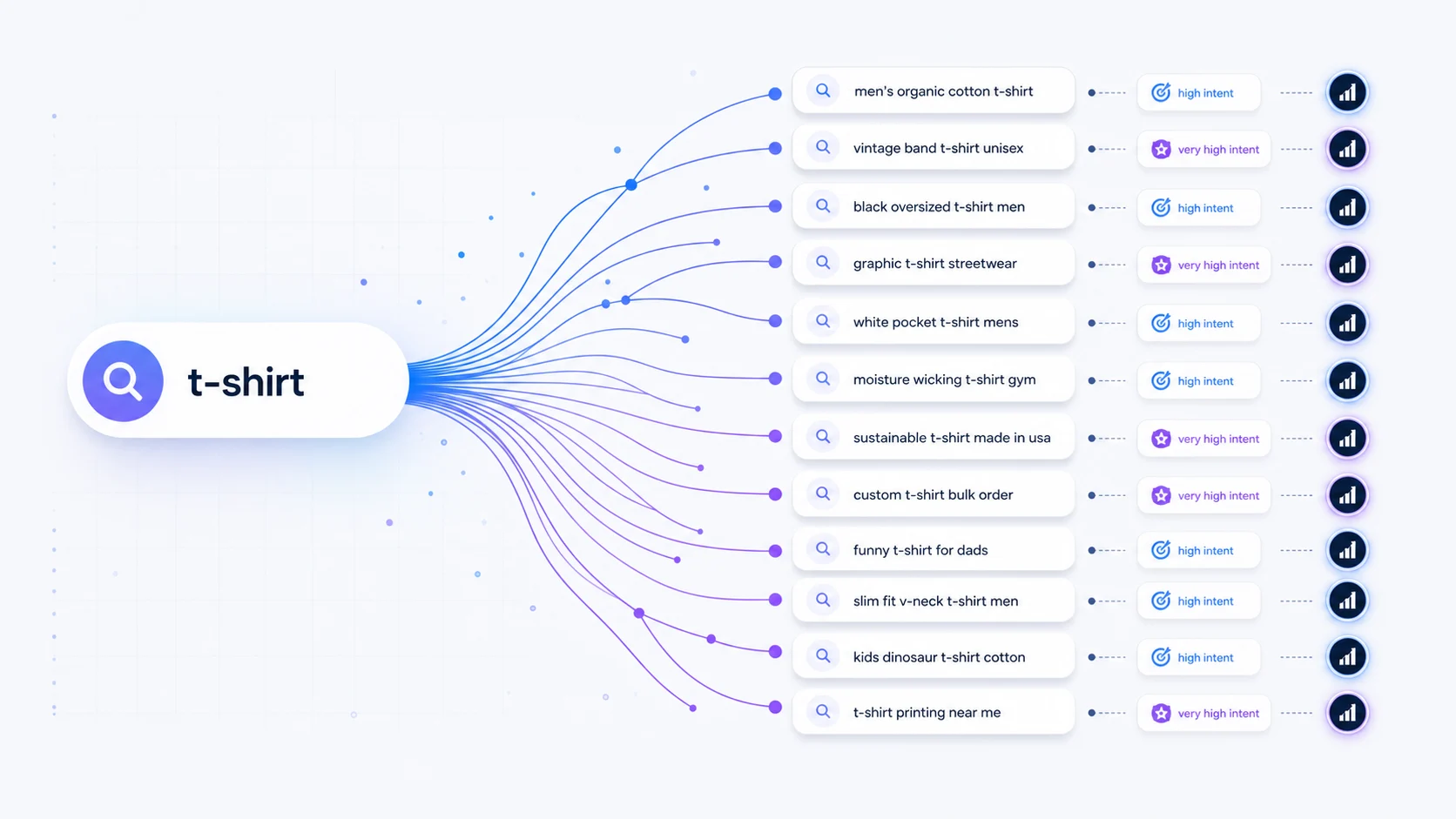
If you have ever poured budget into ranking for a high-volume head term like “t-shirt” only to watch traffic arrive without conversions, you already understand the hidden cost of ignoring long-tail keywords. Long-tail keywords are the longer, more specific search queries that sit at the thin end of the search demand curve, and for most marketers and ecommerce sellers, they are where the real revenue happens. This guide breaks down what long-tail keywords are, why they convert better, how to find them, and how to turn them into pages that rank and sell.
What Are Long-Tail Keywords?
Long-tail keywords are search queries that typically contain three or more words and describe a very specific intent. They get their name from the “long tail” of the search demand curve: a statistical distribution where a small number of head terms receive enormous search volume, while a huge number of highly specific terms each receive a small amount of traffic. Added together, those small volumes often exceed the traffic of the head terms.
- Short-tail (head) keyword: “t-shirt” — search volume around 1.5 million monthly searches in the US, but the searcher could be a designer, a wholesaler, a student looking for a school project image, or a shopper. Intent is ambiguous.
- Long-tail keyword: “custom organic cotton t-shirt for teams” — search volume around 600 monthly searches, but the searcher is almost certainly a purchasing decision-maker at a company, sports team, or organization who wants custom printing on sustainable fabric and is ready to request a quote.
Other long-tail examples across ecommerce:
- “women’s zero drop trail running shoes size 8” instead of “running shoes”
- “stainless steel French press 34 oz insulated” instead of “French press”
- “CRM for boutique law firms under 10 employees” instead of “CRM”
Each long-tail keyword encodes attributes (material, size, use case, price range, audience) that the head term does not. That specificity is exactly what makes long-tail keywords so valuable.
Why Long-Tail Keywords Convert Better
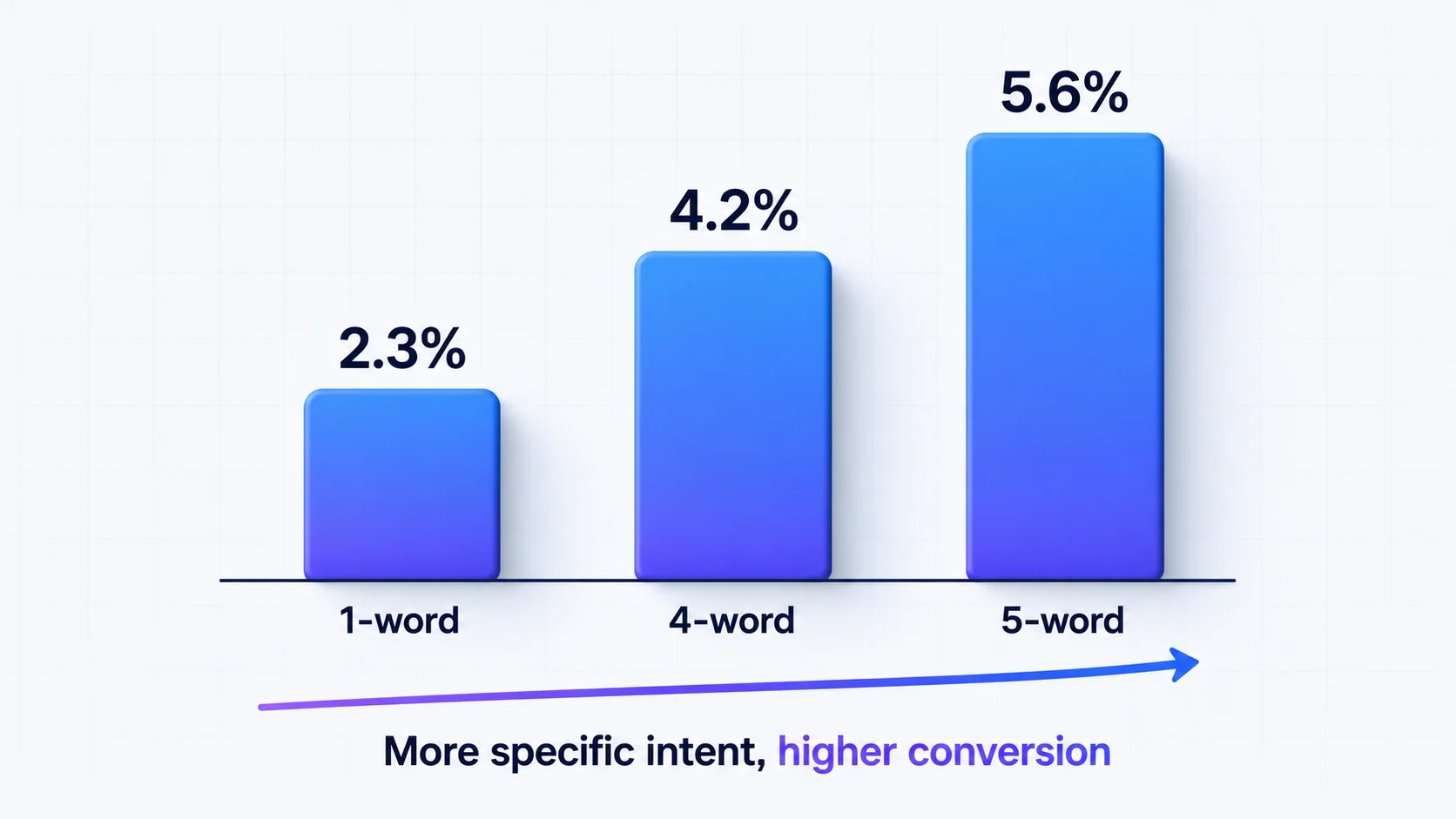
The conversion advantage of long-tail keywords is not a marketing slogan — it is one of the most consistently reproduced findings in search marketing data. An analysis of billions of queries showed that conversion rates for one-word queries were roughly 2.3%, climbed to about 4.2% for four-word queries, and reached 5.6% for five-word queries. That trend has held as search behavior has grown more conversational.
Three forces drive the conversion lift:
1. Specific Intent
When someone types “custom organic cotton t-shirt for teams,” they have already told you exactly what they want. They are not browsing — they are evaluating suppliers. You can write a product page that matches their needs word for word, address every objection (minimum order quantity, print method, lead time, GOTS certification), and present a buy button. With a head term like “t-shirt,” you are guessing at intent and most of your traffic bounces.
2. Lower Keyword Competition
Head terms are dominated by Wikipedia, Amazon, and well-funded brands. A new Shopify store ranking for “t-shirt” is almost impossible. The same store ranking for “custom organic cotton t-shirt for teams” is entirely realistic — that keyword has a competition score a fraction of the head term, and far fewer domains actively optimize for it. Lower competition means faster rankings, smaller link budgets, and a real path to page one.
3. Higher Relevance and Better User Experience
Pages built for long-tail keywords match the query precisely, which reduces bounce rate, increases time on page, and signals to search engines that the result satisfies the user. Over time, that engagement data compounds: better user signals lead to better rankings, which lead to more traffic, which feeds back into authority.
The Math of Long-Tail: Why 100 Long-Tail Keywords Beat 1 Head Keyword
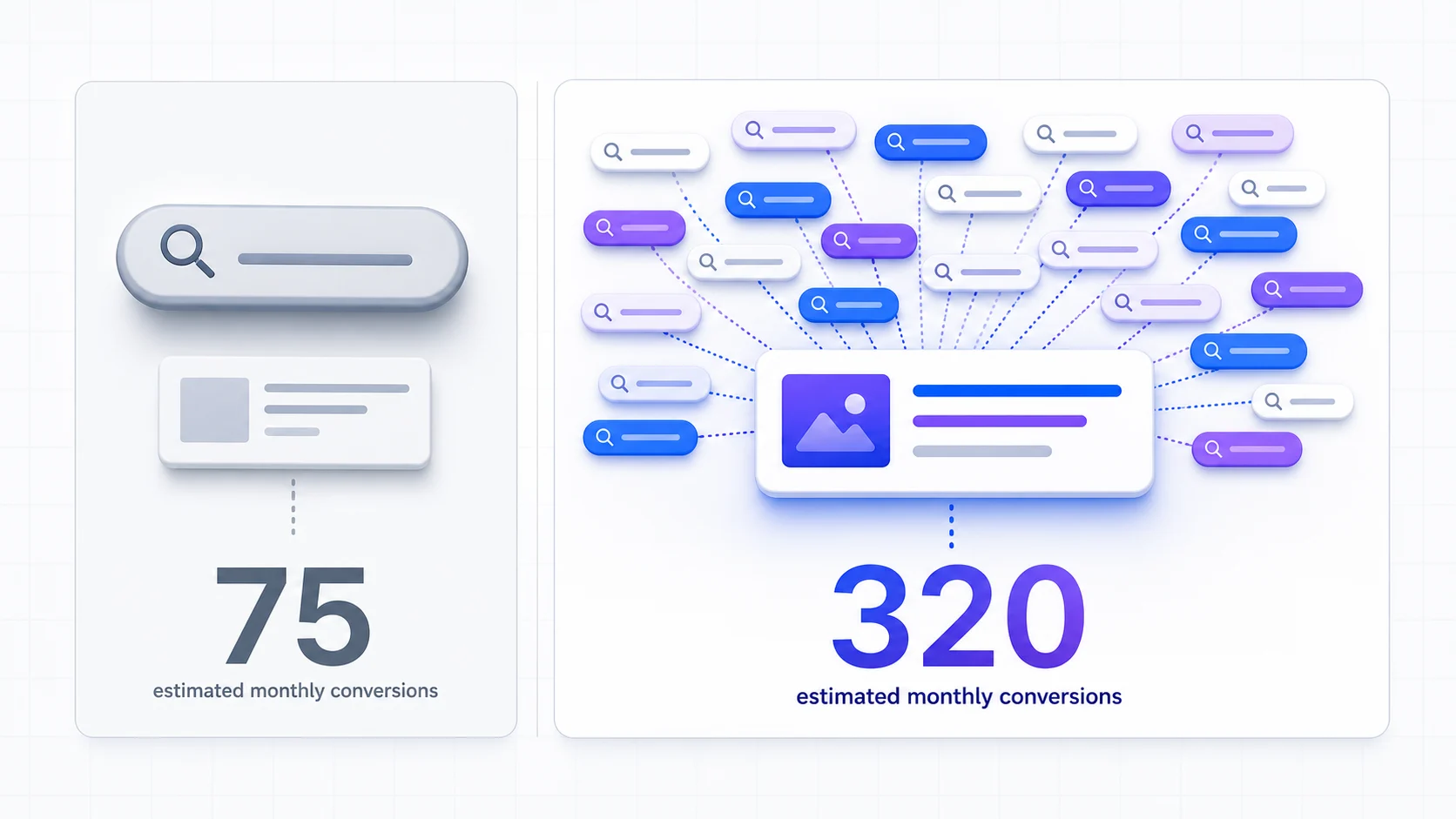
The argument for long-tail keywords becomes obvious once you do the arithmetic. Consider two strategies for the same ecommerce store:
Strategy A — Chase the head term
- Keyword: “t-shirt”
- Monthly search volume: 1,500,000
- Realistic ranking position for a new store: page 3+ (roughly 0.5% click-through)
- Estimated monthly clicks: 7,500
- Conversion rate for vague intent: 1%
- Estimated monthly conversions: 75
Strategy B — Dominate 100 long-tail keywords
- Average keyword search volume: 400
- Total aggregate monthly searches: 40,000
- Realistic ranking position: top 3 (roughly 20% click-through for top-3 organic results)
- Estimated monthly clicks: 8,000
- Conversion rate for specific intent: 4%
- Estimated monthly conversions: 320
Strategy B delivers more than four times the conversions from a fraction of the search volume, and it reaches that position in months instead of years. The aggregate traffic from many long-tail keywords regularly exceeds what a single head term delivers — Google’s own research once estimated that roughly 20% of all searches are queries Google has never seen before, and the long tail captures the bulk of that novel, intent-rich demand. Keyword search volume is a useful signal, but it is not the goal — conversions and revenue are.
How to Find Long-Tail Keywords
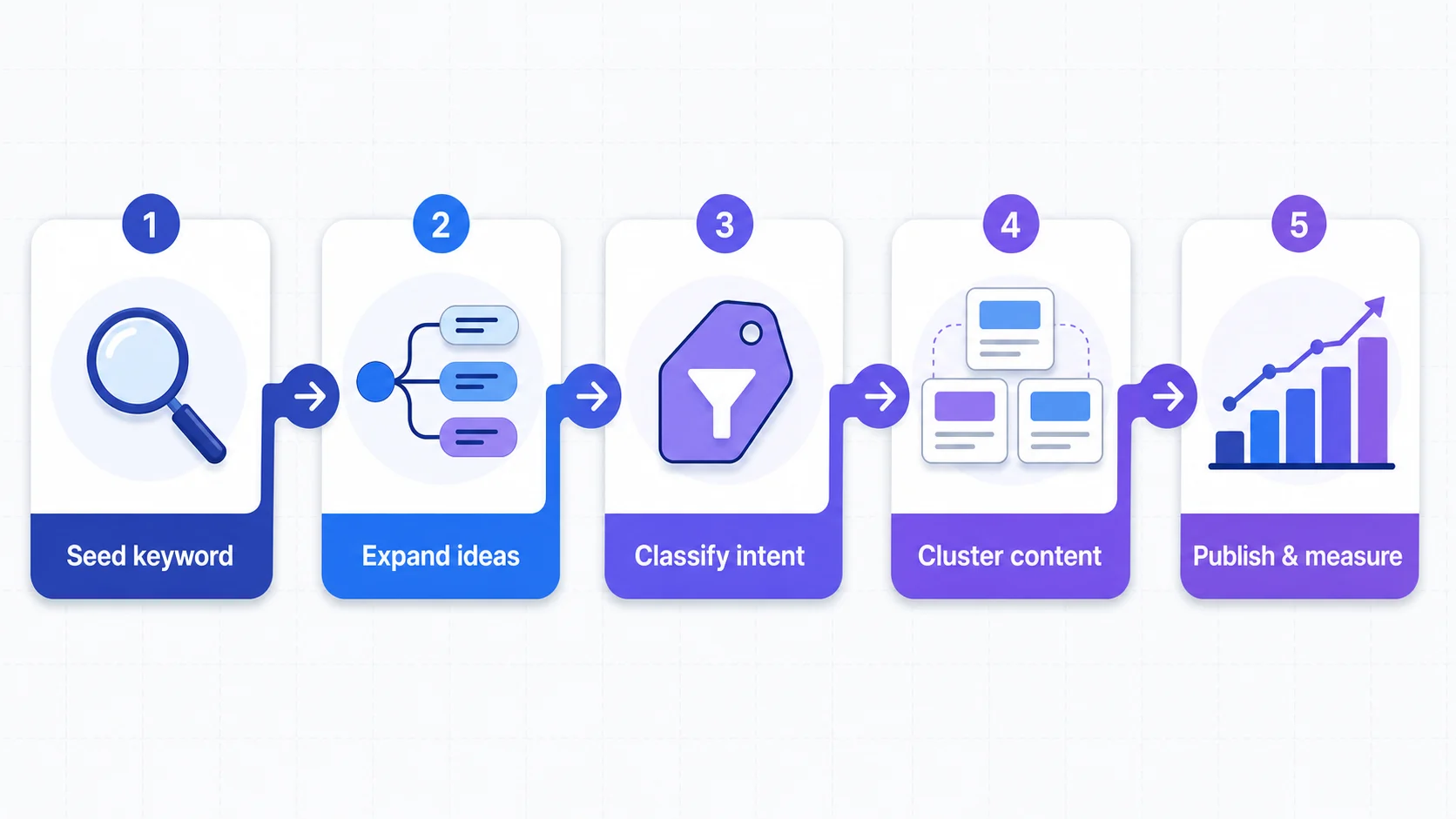
Long-tail keyword research is a repeatable process. You do not need expensive enterprise tools to start — you need a disciplined workflow that combines free discovery signals with a structured database.
1. Autocomplete Mining
Start with a seed keyword and type it into Google’s search box. Autocomplete suggestions are drawn from real user queries, so every suggestion is a validated long-tail keyword. For “organic cotton t-shirt” Google may suggest “organic cotton t-shirt wholesale,” “organic cotton t-shirt men’s,” “organic cotton t-shirt bulk,” and dozens more. Type each letter of the alphabet after your seed to surface alphabetical variations.
2. Keyword Expansion Tools
Manual autocomplete is slow. A tool like Plan Keywords’ keyword expansion feature accelerates this dramatically: enter a seed term, choose quick or deep expansion, and the tool returns phrase ideas, related keywords, and long-tail opportunities pulled from real search data across multiple markets. You can expand a single seed into hundreds of candidate long-tail keywords in minutes and export them for prioritization.
3. Question Keywords
Searchers phrase long-tail queries as questions more often than any other form. “How to wash organic cotton t-shirts,” “are organic cotton t-shirts worth it,” “what is the GSM of a heavyweight organic cotton t-shirt.” Question keywords are gold for blog posts and FAQ pages, and they also surface in “People Also Ask” boxes, which can multiply your SERP real estate. AnswerThePublic, the “People Also Ask” carousel, and Reddit threads all surface question-style long-tail opportunities.
4. Related Searches and SERP Features
Scroll to the bottom of any Google results page and the “Related searches” section hands you eight more long-tail keyword ideas directly from Google’s own clustering algorithm. Repeat the process for each related search and you build a tree of validated long-tail terms. If a query triggers a shopping pack, image results, or a featured snippet, that tells you what kind of content Google expects to rank for that keyword.
How to Organize and Prioritize Long-Tail Keywords
A raw list of 500 long-tail keywords is useless until you organize and prioritize it. The most practical framework is search intent classification. Group every keyword into one of four intent buckets:
Transactional Keywords
The searcher is ready to buy. Examples: “buy organic cotton t-shirt bulk,” “custom organic cotton t-shirt quote,” “wholesale organic cotton t-shirt supplier.” These belong on product pages, category pages, and pricing pages. Prioritize them first — they generate revenue fastest.
Commercial Keywords
The searcher is comparing options before buying. Examples: “best organic cotton t-shirt brand,” “organic cotton t-shirt vs bamboo t-shirt,” “organic cotton t-shirt reviews.” These belong on comparison pages, buying guides, and listicles.
Informational Keywords
The searcher wants to learn. Examples: “what does GOTS certified mean,” “how is organic cotton grown.” These belong on blog posts and educational content. They build topical authority and feed the top of the funnel.
Navigational Keywords
The searcher is looking for a specific brand or page. Examples: “Plan Keywords login,” “Patagonia organic cotton t-shirt.” Usually low priority unless they reference your brand directly, in which case you want to own the result.
A tool like Plan Keywords’ AI keyword analysis can automate this labeling at scale: select a batch of keywords and the AI classifies each one as core, long-tail, opportunity, transactional, question-ready, or likely brand — turning a raw list into a prioritized content roadmap in seconds. Once labeled, sort by search volume, competition, and intent to decide what to build first.
Turning Long-Tail Keywords Into Content
Once your keywords are prioritized, map each cluster to a content type. Different intent buckets call for different page formats:
Product Pages (Transactional)
Every transactional long-tail keyword deserves its own dedicated product or product-variant page. “Custom organic cotton t-shirt for teams” should land on a product page that uses the keyword in the H1, meta title, URL slug, and first 100 words, and that addresses every implied sub-question: minimum order quantity, print methods, lead time, fabric weight, sizing, certifications, and pricing tiers. Long-tail product pages convert at 3-5% routinely, versus 1-2% for generic category pages.
Blog Posts (Informational)
Informational long-tail keywords become blog posts. Aim for 1,500-2,500 words, structure with H2 and H3 subheadings that match follow-up questions, and link internally to transactional product pages. A blog post on “how to wash organic cotton t-shirts” should link to your product page, sizing guide, and bulk-order page. Internal linking passes authority and shortens the path from reader to buyer.
FAQ Pages (Question Keywords)
Cluster question-style long-tail keywords into FAQ pages or an FAQ schema block on existing pages. Google loves FAQ schema and frequently rewards it with rich results. Five to ten well-written Q&As on a category page can earn expanded listings that increase click-through rate by 20-50%.
Landing Pages (Commercial and Mixed Intent)
Commercial-investigation keywords deserve dedicated landing pages that compare options, surface reviews, and present a clear recommendation. “Best organic cotton t-shirt for hot weather” is a perfect landing-page keyword — it lets you showcase your product against alternatives and capture the searcher at the comparison stage.
The golden rule across all four formats: one primary long-tail keyword per page. Trying to rank one page for five unrelated long-tail terms dilutes relevance and confuses search engines. Build one focused page per keyword cluster and let internal links connect them.
FAQ
What is the difference between long-tail and short-tail keywords?
Short-tail keywords (also called head terms) are one- or two-word queries with very high search volume and broad intent, such as “t-shirt” or “CRM.” Long-tail keywords are three or more words, have lower individual search volume, but encode specific intent and convert at much higher rates. Short-tail builds awareness; long-tail builds revenue.
How many words make a keyword “long-tail”?
There is no strict rule, but most long-tail keywords are three to seven words. The defining characteristic is not word count but specificity — “running shoes” is short-tail, “zero drop trail running shoes for wide feet” is long-tail. Aim for intent clarity over word count.
Do long-tail keywords still matter with AI search and voice search?
They matter more than ever. Voice queries are almost always long-tail (“hey Siri, where can I buy custom organic cotton t-shirts in bulk”), and AI-powered search engines like Google’s AI Overviews favor specific, answer-rich queries. Long-tail keywords are the natural language of real questions, which is exactly what conversational search rewards.
How long does it take to rank for long-tail keywords?
For a reasonably optimized site with decent topical authority, long-tail keywords often rank within 4-12 weeks. Very low-competition ecommerce keywords can rank in days. Head terms, by contrast, typically take 12-24 months of sustained effort and link building.
Can I rank for long-tail keywords without backlinks?
Yes, often. Because long-tail keywords have low competition, a well-structured, intent-matched page can rank on the strength of content quality and internal linking alone. Backlinks accelerate rankings and extend the ceiling, but they are not a prerequisite the way they are for head terms.
Conclusion
Long-tail keywords are not a niche tactic — they are the foundation of practical SEO for ecommerce and content marketing. They convert better, rank faster, cost less to win, and aggregate into traffic volumes that rival any head term. The winning formula: find long-tail keywords through autocomplete mining, keyword expansion, and question research; organize them by intent; and turn each cluster into a focused product page, blog post, FAQ, or landing page.
The hardest part is not the strategy — it is the scale. Doing this by hand for hundreds of keywords is a multi-week project. That is exactly the problem Plan Keywords solves: keyword expansion from a single seed into hundreds of long-tail candidates, AI keyword analysis that labels every term by type and intent, and a keyword database that keeps your research organized and actionable. Ready to stop chasing head terms and start capturing the long-tail traffic that actually converts? Download Plan Keywords and build your first long-tail keyword portfolio today.